
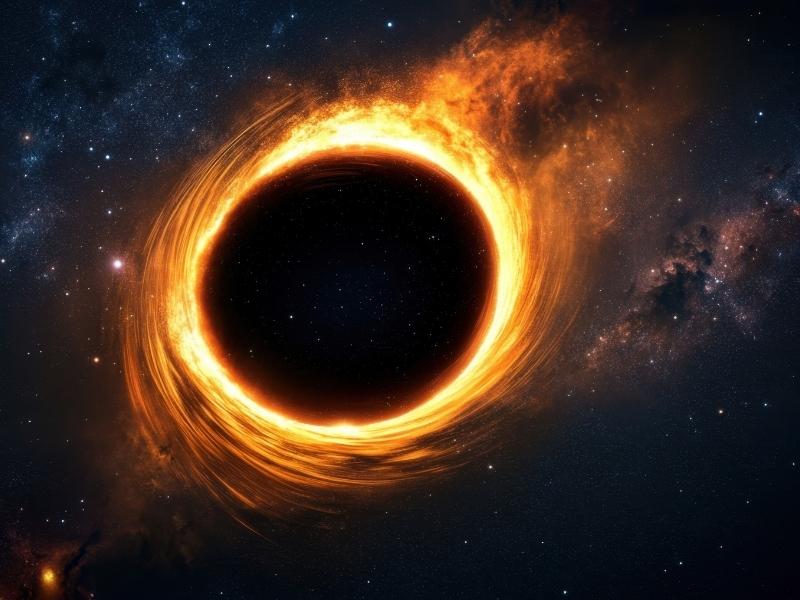
1. Black Holes Are Invisible
They do not emit light, making them invisible; we detect them by their effects on nearby stars and gas.
2. Black Holes Have Extremely Strong Gravity
Their gravity is so strong that nothing, not even light, can escape once it crosses the event horizon.
3. There Are Different Types of Black Holes
From small stellar black holes to supermassive ones found at galaxy centers, black holes vary greatly in size.
4. Black Holes Can Spin
Many black holes rotate at nearly the speed of light, dragging space-time around them.
5. Time Slows Down Near Black Holes
Due to extreme gravity, time near a black hole moves slower compared to farther away in space.
6. Black Holes Can Merge
When two black holes collide, they form a bigger black hole and release powerful gravitational waves.
7. The Closest Known Black Hole Is About 1,000 Light-Years Away
Named V616 Monocerotis, it’s relatively close in cosmic terms but still unreachable with current technology.
8. Black Holes May Help Form New Stars
Their powerful jets can trigger star formation by compressing surrounding gas clouds.
9. Hawking Radiation Allows Black Holes to Evaporate
Theoretical physics suggests black holes slowly lose energy and shrink over time through Hawking radiation.
10. The First Ever Image of a Black Hole Was Captured in 2019
The Event Horizon Telescope captured the shadow of the supermassive black hole in galaxy M87, a historic achievement.

Leave a comment
Your email address will not be published. Required fields are marked *